
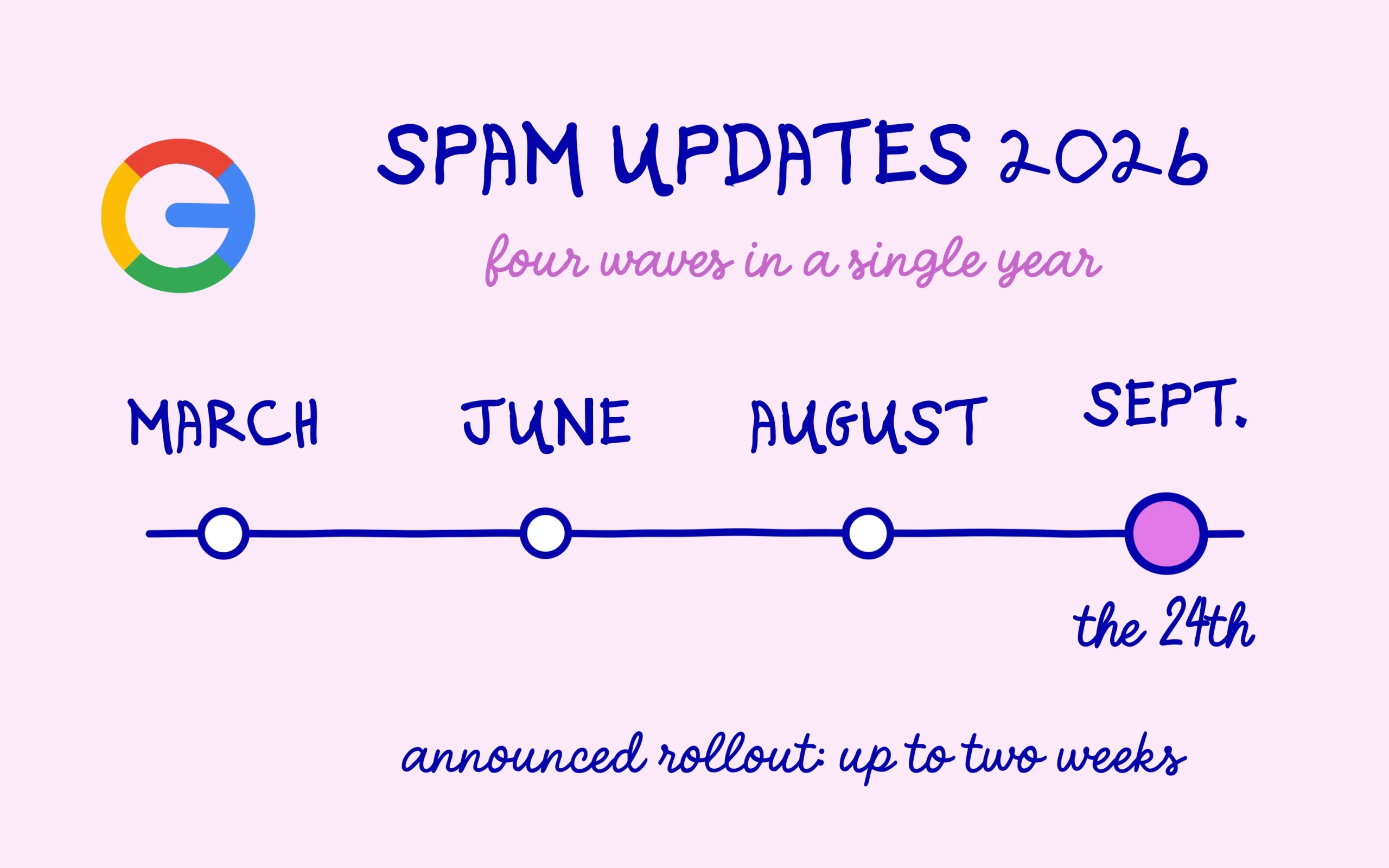
Google started rolling out a new anti-spam update on September 24, and if you watch your rankings closely, your charts may already look different. The official name is the September 2026 spam update, and Google says the rollout can take up to two weeks. A spam update goes after techniques built to manipulate rankings, so it lands hardest on sites that took shortcuts somewhere along the way. Here is what Google actually announced, what it means when you are still learning SEO, and why waiting out the rollout beats reacting to a three-day dip.
TL;DR
Google launched the September 2026 spam update on September 24, across all languages and regions.
The announced rollout can take up to two weeks to finish.
A spam update targets ranking manipulation techniques, while a Core Update reassesses overall page quality.
Wait for the rollout to complete before reading your charts, then review Google’s published spam policies.
Get an AI summary of this article
What Google announced about the September spam update
The announcement sits on Google’s official ranking updates dashboard, the page where every algorithm rollout gets logged with its date. The entry is short: September 2026 spam update, September 24, 2026. That minimal wording is standard for this kind of release, with no detail on which signals changed.
Two details deserve your attention. The first is scope: the update applies to all languages and all regions, so a small English-language blog sits in the same rollout as a large publisher elsewhere. The second is timing. Google states the rollout may take up to two weeks, which means day-one movement tells you very little about where you land at the end.
This release follows the August one closely, and the pattern repeats almost word for word. If you followed how the August spam update hit every language, none of this will surprise you: a short notice, a staggered rollout, and no public list of affected sites.
And the pace is worth noting on its own. Four confirmed spam updates in 2026 so far, in March, June, August, and now September, against a slower cadence in prior years. Google stays quiet on the reason behind that acceleration, so any explanation here is a guess. The calendar itself is the one verifiable fact: it has clearly tightened this year.
What a spam update means when you are new to SEO
Beginners often treat every Google update as one undifferentiated event. A Core Update revisits how the algorithm judges quality and relevance across the board. A spam update works on a narrower problem: strengthening detection of the practices built to game rankings, the ones Google spells out in its published spam policies.
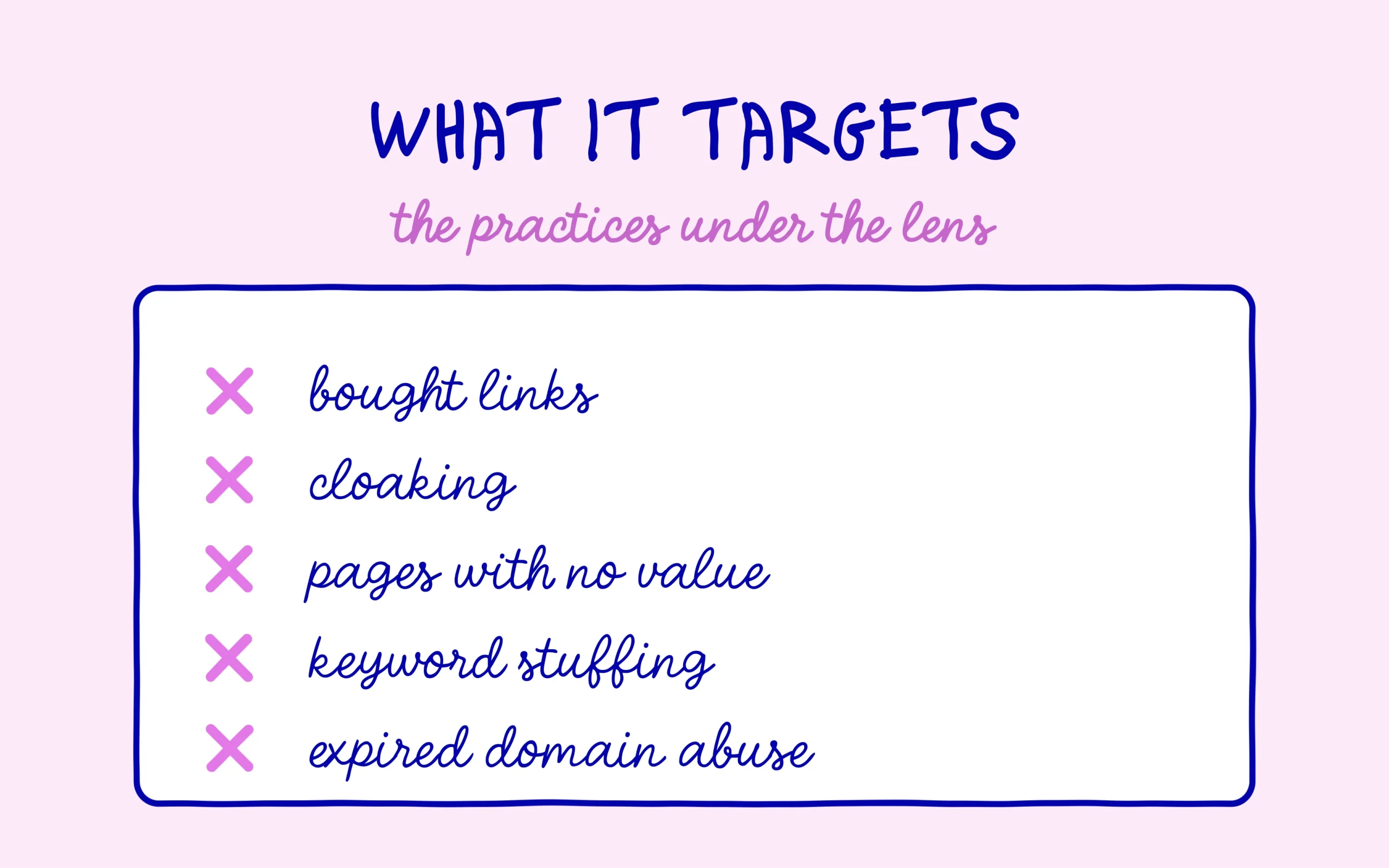
Those policies name specific behaviors: links bought or traded to influence rankings, cloaking that serves one version to Google and another to visitors, mass-produced pages with no added value, keyword stuffing, and expired domain abuse where an old domain gets repurposed for its leftover authority. A site that never touched those tactics has little to fear from a spam update, and that describes most sites in their first year.
One trap catches beginners anyway. Several of those practices get adopted innocently, on the strength of advice found in a forum thread. Buying a cheap link bundle, ordering fifty bulk-generated articles to fill a blog, or picking up an expired domain because someone said it still carried weight are decisions people make in good faith. They still fall inside the boundary Google describes.
The GEO angle reads a bit differently here. Generative engines like ChatGPT or Perplexity do not follow Google’s spam update calendar, and neither has announced anything tied to September 24. But a site that loses organic ranking also tends to get crawled less often, and a page that gets crawled less becomes a weaker candidate for citation by a model looking for fresh information. The effect stays indirect, and it is worth stating as a hypothesis rather than an established fact until data backs it up.
What to do while the spam update rolls out
The most useful first move is restraint. Across a two-week rollout, rankings swing in both directions, and a drop you spot on day three can reverse itself by day ten. Rewriting content in a panic during that window mixes two sources of variation together, and you lose any ability to attribute what caused what.
Three things are worth doing right now. Log September 24 in whatever tracking you keep, so you have a clean before-and-after line once the rollout finishes. Open Search Console and read impressions and clicks page by page rather than as one site-wide number. A drop concentrated on a handful of pages tells a different story than a sitewide decline, and that distinction shapes the entire diagnosis.
Once Google marks the rollout complete, reading the spam policies line by line becomes the productive step. The exercise is an honest audit of whether anything on your site matches a described case, including work done by a previous agency or freelancer. If nothing matches, the decline likely came from somewhere else, and you have eliminated one branch of the diagnosis.
The most common temptation runs the other way: reacting to a spam update by touching dozens of pages at once. The clearer approach isolates the three or four pages showing the sharpest signal in Search Console, rather than reworking everything simultaneously. That produces a readable diagnosis and keeps you from losing track of what actually moved the needle.
One habit worth building regardless of this specific update: keep a simple log of every algorithm change you act on, with the date, what you touched, and what happened afterward. A site owner who tracks three or four updates this way starts spotting patterns a single event never reveals on its own.
Keep learning on SEO Noobies.