
HubSpot, the marketing software company whose blog taught a whole generation of marketers how inbound content works, lost about 80% of the traffic search engines used to send it. Its chief marketing officer, Kipp Bodnar, explained in an interview published on October 29 what the company did after that drop, and what it now watches to measure growth. The headline number is brutal, yet the part that matters more for a small site comes right after it: HubSpot’s revenue kept growing over the same period. If your own visits have been sliding since AI answers showed up in search results, this case gives you a clearer idea of what to track. Here are the facts, the limits of those numbers, and what you can apply at your own scale.
TL;DR
HubSpot lost roughly 80% of its organic traffic after its blog peaked at more than 20 million visits a month.
Its revenue still grew by nearly 20% in 2025, according to CMO Kipp Bodnar.
The company now tracks revenue per visit, its share of voice in AI answers, and the sales pipeline its content influences.
For a small site, the useful habit is to tie each page to what it earns before reacting to a falling traffic chart.
Get an AI summary of this article
How Much Traffic HubSpot Actually Lost
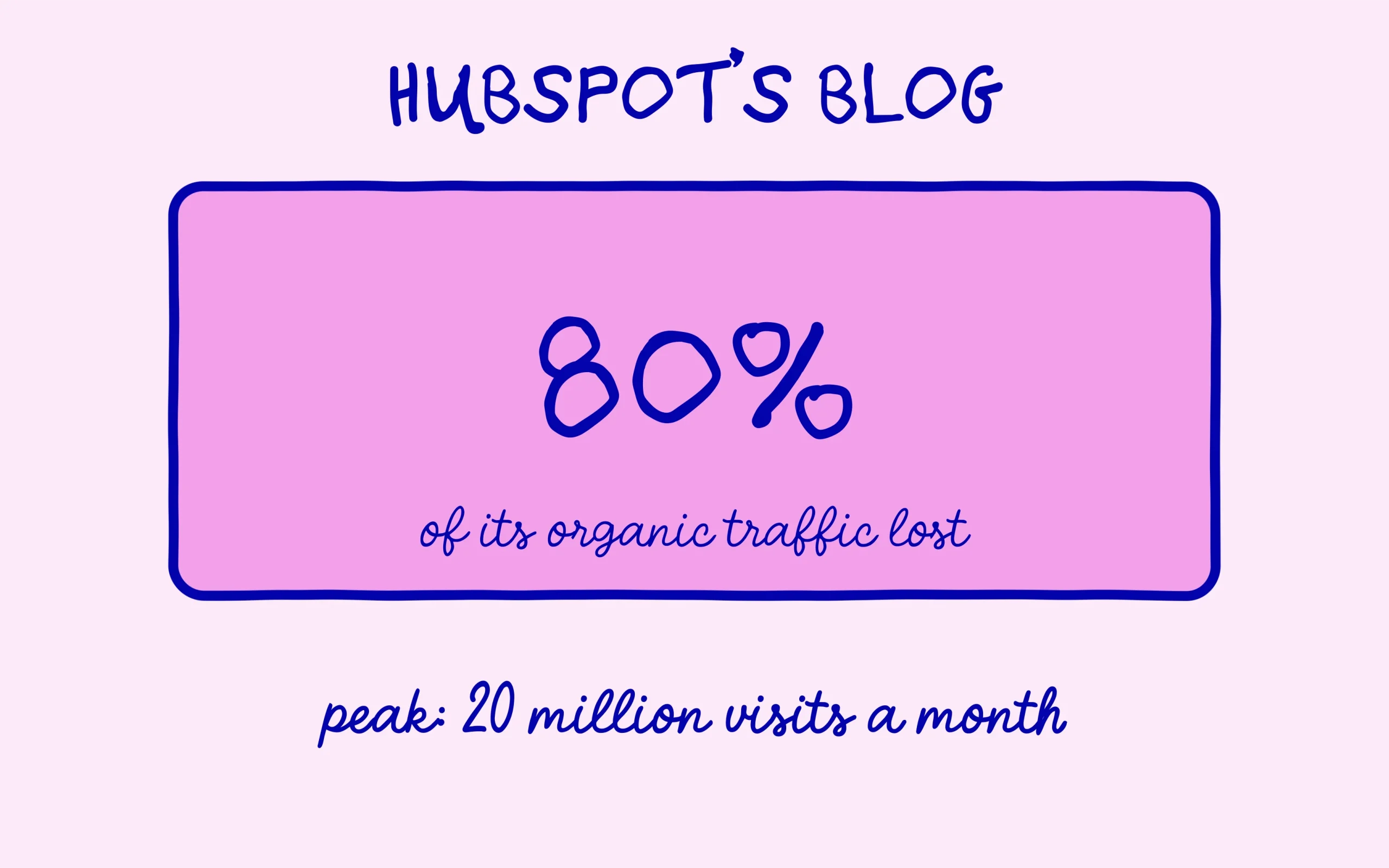
For years, HubSpot’s blog was one of the most visited resources in online marketing. Kipp Bodnar puts its peak at more than 20 million organic visits a month, meaning visits from unpaid search results. About 80% of that traffic disappeared as AI-generated answers spread across search engines.
He walked through those numbers in his interview with Greg Jarboe for Search Engine Journal, timed with the release of Loop, the book he co-wrote with Kieran Flanagan. One detail stands out: HubSpot lost nearly 5 million visits in a single thirty-day stretch right after Google rolled out AI Overviews, the summaries it shows above its classic results.
The surprising part comes next. While traffic fell, HubSpot’s revenue grew by nearly 20% in 2025, Bodnar said. Content leads, the contacts who leave their details after reading an article or downloading a guide, now come about 90% from channels that barely mattered five years ago. The blog brings in only around 10% of them.
Bodnar also shared numbers on visitors sent by AI assistants. In his telling, they convert at roughly three times the rate of classic search visitors, and qualified leads from AI answers rose 1,850% between the first quarter of 2025 and the first quarter of 2026. Those figures come from HubSpot and likely start from a very small base. Jarboe flags that in his piece, and Bodnar admitted himself that attributing sales to a single channel is imperfect.
It’s worth staying careful with that last claim. Data from other sites has shown that traffic from AI assistants doesn’t always convert better than Google traffic. HubSpot’s result depends on its product, its very well-known brand and its own way of counting, which makes it hard to copy onto a different site as it stands.
Revenue Per Visit, AI Share of Voice and Pipeline
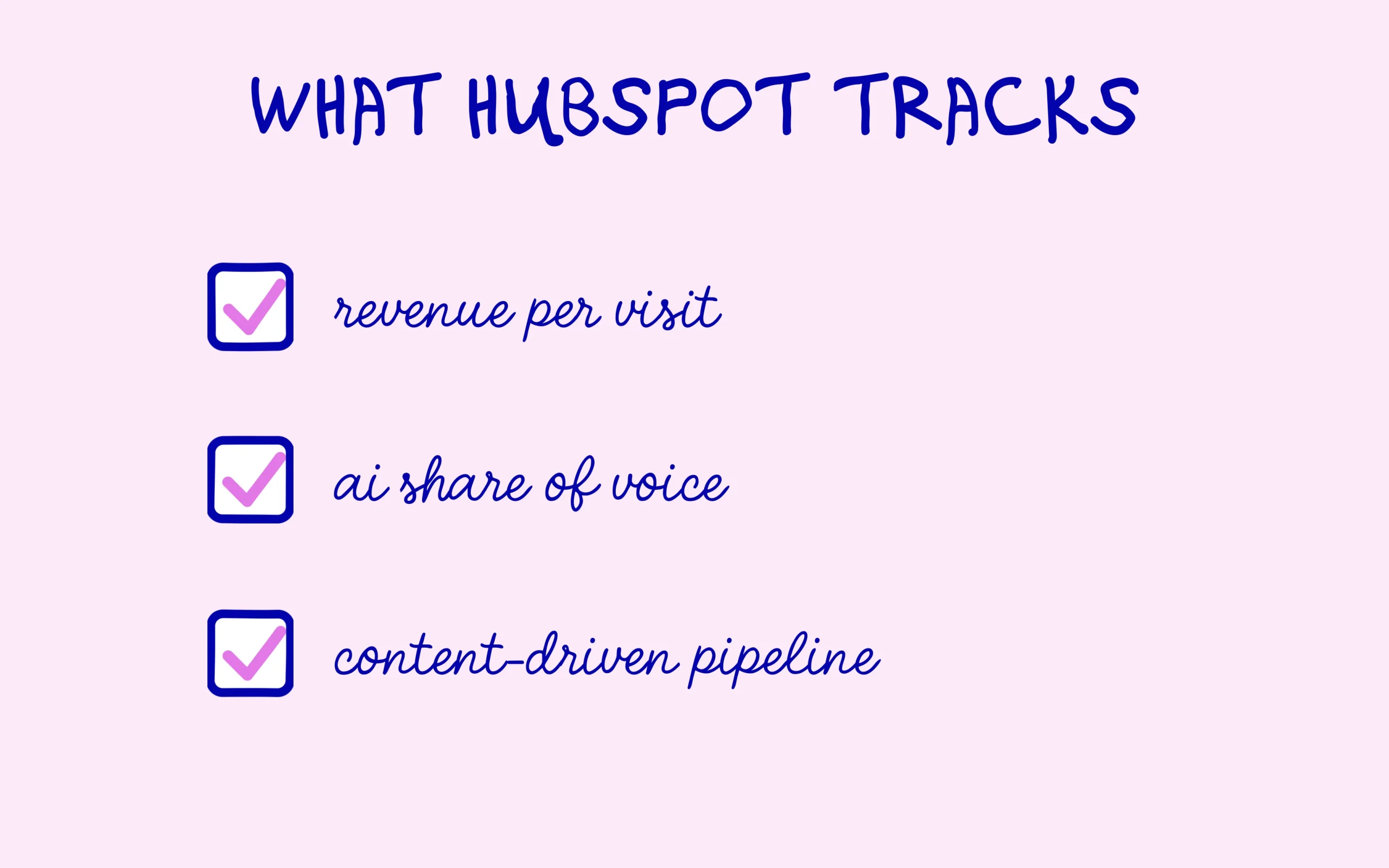
The most useful moment in the interview is short. Website traffic used to be how the team tracked growth, Bodnar said, and today it looks at three other measures: revenue per visit, AI share of voice and content-influenced pipeline. All three sit closer to money than a raw visit count does.
Revenue per visit divides what the site earns by the number of visits it gets. A page that attracts few people but sells well ends up weighing more than a popular page that never leads to a request. For a publisher whose visits have shrunk, that calculation judges every page on what it actually brings to the business.
AI share of voice measures how often a brand shows up in assistant answers compared with its competitors, across a set of prompts followed over time. HubSpot separates two cases here. A mention is when the AI names the brand, and a citation is when it points to one of its pages with a link. If you want to see where you stand without paying for a tool, there is a method to check your AI citations for free.
Content-influenced pipeline groups the sales opportunities where an article, a video or a guide played a part before the deal closed. The team also tracks the outside sources AI engines rely on when they talk about HubSpot, such as Reddit, LinkedIn, YouTube and G2, a software review platform.
One more detail is worth keeping in mind. Bodnar notes that prompts typed into AI assistants now often run 40 to 100 words, while a classic Google search runs two to four. A prompt that long describes a whole situation, which is one more reason to write pages that answer specific cases.
Discover the SEO Noobies agency
What a Small Site Can Borrow From This
Most SEO Noobies readers run sites with a few dozen pages, nowhere near HubSpot’s 20 million monthly visits. The logic still scales down well. Before worrying about a traffic line heading south, you need to know which pages actually earn something.
In practice, Google Search Console shows which queries and pages get clicks, and an analytics tool such as Google Analytics shows which of them lead to a quote request, a purchase or a sign-up. Putting the two side by side for the last three months often reveals that a handful of pages do most of the work. A page that loses visits but keeps its customers can wait its turn.
Keep the wider context in view too. Searches that end without any click had already become common before HubSpot’s story made headlines, as the data on zero-click Google searches in 2026 showed. A drop on informational pages is part of that trend, and it calls for a calm look at your best pages first.
On the AI side, the simplest habit is to regularly ask ChatGPT, Perplexity or Gemini the questions your customers would ask, then note whether your brand appears, with or without a link. A manual log like this is rough, and it already gives you a first sense of your share of voice.
HubSpot’s case also shows that AI assistants draw on sources outside your own site. The company watches those sources because they feed what the engines say, and a small site can follow the same logic by looking after its presence wherever customers discuss its trade, on YouTube, LinkedIn or review sites.
Keep learning on SEO Noobies.